


Your Google Ads campaign could be doing exactly what you told it to do.
And that might now be the problem.
Google has changed how target-based bidding behaves when campaigns are limited by budget. If your campaign has been quietly outperforming an old CPA (Cost Per Acquisition) or ROAS (Return on Ad Spend) target, that target now matters more than it did before.
For healthcare businesses, where every enquiry and advertising dollar counts, it’s worth checking whether the number Google is optimising towards still reflects what good performance looks like today.
Where does this fit into the Healthcare Growth Equation?
At Splice, we look at growth through four connected variables:
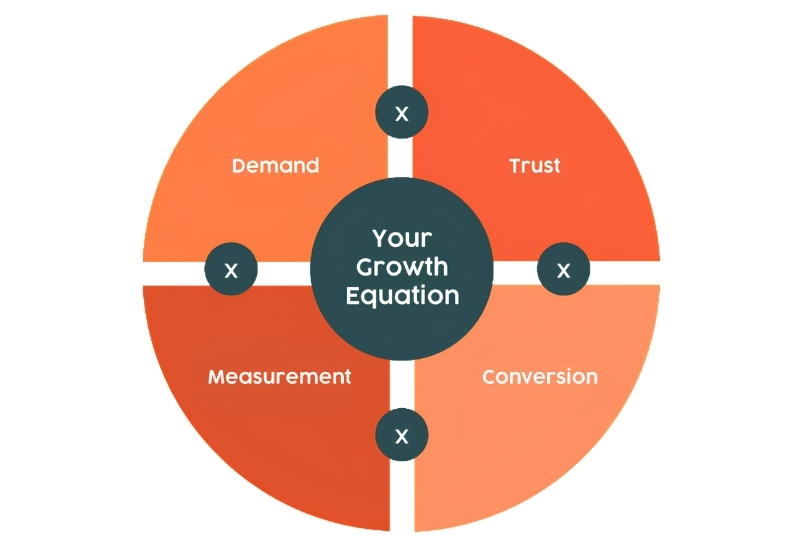
This Google Ads update sits mainly across three of them:
- Demand: Are the right patients or healthcare buyers finding you?
- Conversion: Are those clicks turning into bookings, enquiries or qualified leads?
- Measurement: Is Google optimising towards the right conversion and the right target?
That last one is the key here.
Google can optimise very efficiently towards the wrong target if that’s the target you’ve given it.
So, what has actually changed?
If a campaign is Limited by budget and uses a target-based bidding strategy, Google will now work more consistently towards the target you’ve set.
For example: If your Target CPA is $100, but your campaign has historically been generating enquiries for $70, Google may now move performance closer to that $100 target. Nothing is necessarily broken. Google is simply paying closer attention to the number you told it to aim for.
The important question is: Does that number still make sense for your business?
Why this matters in healthcare
Healthcare campaigns tend to operate within tighter limits than many other industries.
You might have a very specific patient acquisition budget, a limited number of appointments available, or a longer path between someone clicking an ad and becoming a commercially valuable lead. And not every conversion is worth the same thing.
A campaign might count all of these as conversions:
- appointment bookings
- contact form submissions
- phone calls
- referral enquiries
- demo requests
- brochure downloads.
If Google is optimising towards all of those equally, a low CPA might look great without necessarily driving meaningful growth.
That’s why this update isn’t just about bidding. It’s also about whether your measurement setup is giving Google the right signals.
The campaign you’re least worried about might be the one to check first
If a campaign is underperforming, chances are you’re already watching it. But what about the one that’s been quietly beating its target for months?
Say you originally set a Target CPA of $120.
Since then, you’ve improved the landing page, refined the campaign and strengthened the booking process. Your actual CPA has fallen to $80. Great result.
But if the target is still sitting at $120, Google may now work more closely towards that older number. Your campaign has improved. Your target hasn’t.
That’s where the risk sits.
What should you review?
You don’t need to overhaul your Google Ads account. Start with four things.
1. Find campaigns that are Limited by budget
Look for campaigns using target-based bidding that are currently, or have recently been, Limited by budget. These are the campaigns most relevant to the update.
2. Compare your target with actual performance
If your Target CPA is $120 but your recent actual CPA has consistently been closer to $80, ask why.
- Has performance improved?
- Has the landing page changed?
- Has your conversion rate increased?
- Or was the original target simply never updated?
Your target should reflect what a valuable patient, enquiry or lead is actually worth to your business.
3. Check what Google is counting as a conversion
This is especially important in healthcare. Ten appointment bookings are very different from ten button clicks. Ten qualified medtech leads are very different from ten brochure downloads.
Before changing your bidding target, make sure Google is optimising towards actions that actually matter.
4. Don’t make changes based on one or two days of data
Healthcare conversion cycles aren’t always immediate. A patient may click today and book next week. A medtech lead may take even longer. Make considered changes, give them enough time and data, then assess the result.
The bigger lesson
Google will keep changing. Bidding systems will change. Search behaviour will change. Automation will increase. The goal isn’t to react to every platform update. It’s to understand your marketing well enough to know whether the update actually matters to your business.
Maybe Demand is strong, but your website isn’t converting.
Maybe your ads are generating enquiries, but they’re the wrong type.
Maybe the campaign is performing well, but Measurement is telling Google to optimise towards something that isn’t commercially valuable.
That’s why we diagnose before adding more activity.
Since the update, we’ve been reviewing campaign targets more closely and adjusting them based on recent performance.
Where campaigns are spending efficiently, we’re making measured changes to improve cost per conversion over time. The key is finding the right balance: push targets too aggressively and Google’s algorithm can become more selective about when your ads appear, which may reduce traffic and ultimately lead to fewer patient enquiries or conversions.
Every campaign behaves differently, so these adjustments need to be made based on individual account performance rather than a one-size-fits-all formula.
Encouragingly, we’ve already seen positive movement across several campaigns since the change. One of our higher-converting accounts has generated 101 conversions while reducing its cost per conversion by 22.27% across Search and Performance Max campaigns.
The takeaway?
Strong Google Ads performance comes from ongoing optimisation, careful interpretation of the data and knowing when to prioritise efficiency versus visibility and growth.
Not sure whether your account is affected?
At Splice Marketing, we work exclusively with healthcare businesses, helping practices, healthcare organisations and medtech companies understand what’s actually limiting growth before adding more marketing activity.
Book a free strategy session and let’s find out whether there’s actually something to fix.