


Black Friday has become difficult for Australian advertisers to ignore.
Australia Post reports that 3.1 million Australian households shopped online over the 4-day Black Friday and Cyber Monday period in 2025, spending around $1.5 billion. Some 44% of shoppers said they looked forward to the event, making it Australia’s most anticipated sales period.
That surge in consumer spending drives a sharp increase in advertising competition. In November 2025, the cost of reaching Australian audiences on Meta was around 50% higher than the typical level recorded across the surrounding year.
So, what does this mean for your healthcare business? If you’re a healthcare practice, the priority is maintaining visibility and attracting patient enquiries in a more competitive market. If you sell healthcare products, the question is different – will stronger purchase intent offset the higher cost of advertising?
Why Black Friday can hit Meta harder than Google Search
When your potential patients’ Meta feeds are flooded with Black Friday ads, it’s harder (and costlier) for you to gain their attention. That means a physiotherapy clinic advertising on Facebook may feel the effects of Black Friday activity even though it sells nothing remotely similar to shoes, electronics or furniture.
Google Search is different. Retailers might be pouring money into Black Friday Google Ads, but that does not automatically translate into a sharp cost increase for every medical search.
That’s because Google’s ad auctions compete search by search. If someone types “cardiologist near me”, Google looks at the advertisers eligible for that query and decides which ads to show based on factors including bid, competition, and the relevance of the ad and landing page.
Your own Google Ads data will tell you the most. If you’re paying more for clicks but receiving fewer enquiries, it’s worth looking beyond your advertising costs. Are fewer patients searching for your services, or are people visiting your website but not booking? Understanding where the drop-off happens can help you make more informed decisions about your budget.
Healthcare practices should not start behaving like retailers
Black Friday is designed to encourage faster purchasing decisions through the lure of a time-limited discount. Healthcare services work differently. Someone searching for a dermatologist, psychologist or orthopaedic surgeon is usually responding to a health need, not waiting for a 30% discount before deciding to act.
For most practices, the better strategy is to protect the Demand that already exists.
That means:
- Staying visible when patients are actively searching for your services.
- Keeping your budget focused on the services you want to grow.
- Monitoring whether your cost per booking or new patient remains commercially viable.
If Meta becomes more expensive during the period, lower-priority campaigns may deserve closer scrutiny. But broadening activity simply to maintain traffic can waste your money.
A retail-style “Black Friday treatment sale” is usually uncalled for. Ahpra advertising requirements still apply during promotional periods, meaning your advertising cannot be false or misleading, create unreasonable expectations or encourage indiscriminate or unnecessary use of health services. If you advertise a gift, discount or other inducement, you must clearly state the terms and conditions for your offer.
For healthcare practices, Black Friday is less about creating artificial urgency and more about protecting visibility among patients who are already looking for care.
Healthcare product businesses have a different opportunity
For businesses selling eligible healthcare products, Black Friday can create genuine additional demand.
Australians spent $82.6 billion online in 2025, up 14% year on year. But higher purchase intent does not automatically make a Black Friday campaign profitable.
Say a product normally sells for $100 with a $40 gross margin. You discount it to $80 and your margin drops to $20 before advertising, payment fees, freight and fulfilment. If your cost to acquire a customer also rises during Black Friday, a campaign can generate plenty of revenue while contributing very little profit.
So, before increasing your advertising budget, work backwards from the numbers and ask yourself:
- What can you afford to pay for a sale at the promotional price?
- How much stock do you have?
- Can your checkout handle an increase in traffic?
- Does the offer still stack up once fulfilment and advertising costs are included?
There is also a compliance layer. If you advertise therapeutic goods, TGA advertising requirements may apply and your promotion must also comply with Australian Consumer Law.
In its review of 2025 Black Friday promotions, the ACCC said around half of the 50 retailers it examined made claims that raised concerns. Issues included misleading urgency and questionable representations about discounts.
A successful Black Friday promotion isn’t just about generating more sales. It’s about making sure those sales are commercially worthwhile.
Protect performance before you increase spend
Whether you’re a healthcare practice looking to attract more patients or a healthcare product business aiming to increase sales, avoid reacting to every increase in cost per click. Instead, focus on what happens after someone clicks your ad.
Are enquiries turning into appointments? Are customers completing purchases? And most importantly, is your marketing investment delivering a worthwhile return?
For a healthcare practice, useful measures include:
- cost per qualified enquiry
- cost per booking or new patient
- enquiry-to-booking conversion rate
- lead quality.
If you sell products, also watch acquisition cost, conversion rate, average order value, gross margin and promotional profitability.
Then check the basics behind those numbers, such as:
- Are calls, forms and online bookings being tracked properly?
- Can someone quickly work out how to make an appointment?
- Does the site work properly on mobile?
For ecommerce, check product availability, shipping information and checkout before you increase traffic. Paying for extra visitors to discover an out-of-stock product or a frustrating checkout is an expensive way to find a website problem.
Support paid advertising with a broader Demand strategy
Black Friday also exposes a weakness in businesses that rely too heavily on paid media. If your only way of reaching prospective patients or customers is to buy their attention, a more competitive advertising market leaves you exposed.
Healthcare practices can continue capturing Demand through local SEO, Google Business Profile visibility and useful content around the services and health questions people are already searching for. Consent-based email marketing can also help you communicate with an existing audience without paying Meta or Google to reach them again.
For healthcare product businesses, strong product pages and educational content can support organic discovery and help customers make purchasing decisions before they reach the checkout.
Building these channels takes time, but investing in them now can help reduce your reliance on paid advertising when competition increases.
Look at Black Friday through the Healthcare Growth Equation
At Splice, we use the Healthcare Growth Equation to work out where growth is being constrained:
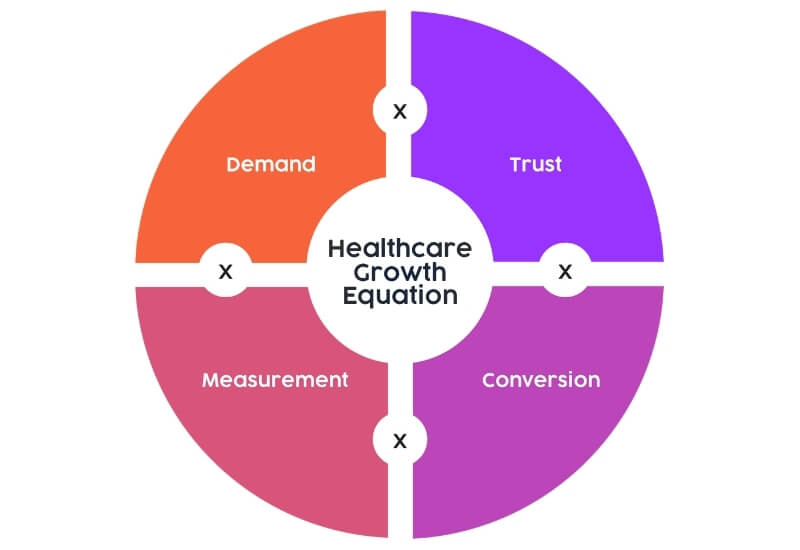
Black Friday can put pressure on all parts of that equation:
Demand
Are you still visible to patients looking for your services or consumers researching products you sell
Trust
Does your advertising give people a credible reason to choose you without relying on exaggerated claims or artificial urgency?
Conversion
Once someone arrives, can they easily book, enquire or complete a purchase?
Measurement
Do you know what each booking or customer is costing you, and whether the result is commercially worthwhile?
If Demand is strong but website visitors are not booking, spending more on ads will not solve the problem. If your conversion rate is healthy but you cannot see which campaigns generate profitable patients or customers, the constraint may be Measurement.
That is why we recommend diagnosing the growth system before changing the marketing plan. You can do that by completing the Healthcare Growth Scorecard or booking a free strategy session with Splice Marketing.