


Part three of a series on diagnosing growth instead of guessing at it.
When I first started talking publicly about the Healthcare Growth Equation (Growth = Demand × Trust × Conversion × Measurement), I was speaking almost entirely to healthtech. Software founders, platforms, digital health companies. That was the room I was in.
The most useful piece of feedback I’ve had on the framework came from someone who wasn’t in that room at all. A CEO from the NDIS allied health world read it and replied that it, “Holds up beautifully on second read,” before showing me exactly what it looked like in his corner of the sector.
He was right. And his point sharpened something I’d suspected for years but hadn’t said plainly enough: the Healthcare Growth Equation doesn’t care what kind of healthcare business you run. The language changes, the metrics change, the regulators change, but the four pillars don’t.
This article is the proof of that. A diagnostic only has value if it holds across the whole field, not just the corner where it was first developed.
The same four pillars, in very different buildings
From the outside, scaling healthcare businesses may look nothing alike. A telehealth platform spending hundreds of thousands a month on paid acquisition has almost nothing in common with a suburban dermatology clinic, which in turn looks nothing like an NDIS allied health provider relying on support coordinators for referrals. Different buyers, different economics, different rules.
And yet, when growth stalls, it’s because one of the same four pillars is crumbling. The Splice Marketing team and I have seen it enough times now to stop being surprised by it. The pillars are:
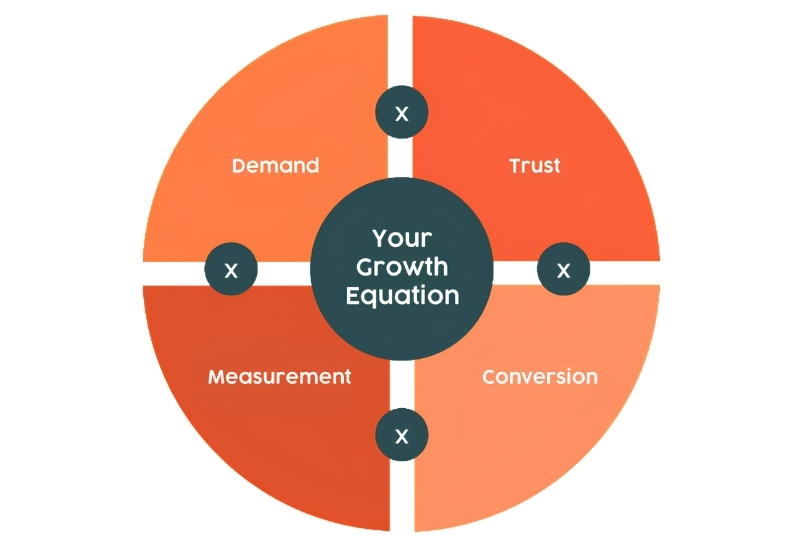
The only thing that varies is which pillar crumbles first and what it is made of in their particular world. Time for a tour of the healthcare sector because the variation is the whole point.
Demand: same need, different appearance
In healthtech, demand is often latent. The market doesn’t yet know it needs what you’ve built – after all, nobody knew they needed an AI scribe before they tried one. Businesses like these need a longer runway to create demand before anything else in the equation can fire.
In a consumer clinic, demand looks completely different. It’s the patient making a 3am search for a symptom they’re not yet ready to mention to their GP, or someone typing a treatment plus “near me” into Google. Here demand is largely about being the most findable, most relevant answer at the exact moment of need. Patient acquisition is built on service-intent search rather than category creation.
In NDIS allied health, demand looks different again. The “buyer” generating demand often isn’t the end client at all, but the support coordinator, NDIS planner or local GP deciding where to send people. Demand here is downstream of referrer relationships in a way it simply isn’t in the other two models.
Three businesses, three completely different demand-generation playbooks. But the underlying factor is identical: does what you offer match a need someone is actively feeling, and are you present at the moment they feel it?
The tactics are local, but the factor is universal. There’s also a mindset that travels across all three: never treat existing demand as a fixed ceiling. The businesses that win keep ratcheting the target: you reached ten, now reach twelve.
Trust: the factor most likely to silently hit zero
Trust is where the universality is most striking, and also where the local variation runs deepest.
In healthtech, trust is a defendability problem. Marketing might convince a clinician to champion your product internally and take it to procurement. But then legal asks for compliance documentation that doesn’t exist, and the executive team wants peer-reviewed evidence. The company’s product has to be defended in a room they’re not in – and they haven’t equipped anyone to do that.
In a consumer clinic, trust is built on different signals: practitioner credentials, a legitimate and consistent brand presence, transparent and informative patient information, and Ahpra/TGA compliance framed as a mark of professionalism.
Patients act on evidence: subject matter expertise, track record, and a strong local reputation. This is a sector where belief beats faith, to borrow a useful distinction. Belief is confidence grounded in historical evidence; faith is confidence regardless. Healthcare buyers run almost entirely on belief, which means your trust factor has to be built on accumulated proof, not persuasion.
In NDIS allied health, the CEO who challenged my framework put it better than I could. As he described it, “In our field, trust hides a sub-multiplier most founders miss: referrer confidence with support coordinators, planners, and GPs. Demand and conversion are largely downstream of it.”
The trust that matters isn’t only the end client’s. Those who decide whether to send patients your way must trust you first. Lose that, and your pipeline dries up before a single client ever hears your name. The CEO’s closing observation stuck with me most: “Most stalled founders I’ve watched were optimising the wrong variable.” That single sentence sums up the entire case for the Healthcare Growth Equation.
That’s three different mechanisms – defendability, patient evidence, referrer confidence – and one identical truth underneath.
Trust is the factor most likely to quietly drop toward zero while everything else looks healthy, and because the equation multiplies, it takes everything else down with it. MediSecure had demand and conversion at scale; a data breach took trust to zero, and the company became insolvent. The mechanism was specific to them. The lesson belongs to everyone.
Conversion: friction is friction, wherever you find it
Conversion is the most mechanical of the four, which is exactly why it travels so cleanly. The principle is the same in every corner of healthcare: maximum result, least effort, least friction. Find the single change that removes the most drag, and it almost always beats spending more.
In healthtech, that friction is the extra step between the technology and the workflow. A GP who has to copy notes from an AI scribe into their clinical software will abandon it in favour of an integrated platform. The winning business is the one that removed the extra step.
In a consumer clinic, friction is the booking form that asks for too much, the pricing that confronts a cold visitor before they understand the value, the enquiry that has no follow-up process behind it. We’ve watched a clinic recover lost conversions simply by reframing how pricing was presented – same information but placed in a context where people understood the value, so they experienced far less booking friction.
The deeper point, and one worth stressing in healthcare specifically, is that conversion is hiding retention. First-visit conversion matters, but lifetime value and repeat and referral behaviour often matter more. Nurture activity that encourages someone to rebook is still conversion – it is just conversion applied to trust, continuity and relationship-building. A clinic that optimises only for the first booking is missing a large part of the growth opportunity.
Measurement: the lens, not just a number
Of the four, measurement is the one I’ve come to think about most carefully, partly because a thoughtful challenge made me refine it. Measurement isn’t quite the same kind of thing as the other three. Demand, trust and conversion are outcomes you generate. Measurement is the instrument you use to see them – the lens, not just a number you multiply in.
That reframe makes it more important, not less. Measurement is what tells you whether you actually got twelve instead of ten. It’s how you read each of the other three factors honestly enough to know which one is failing. The dermatology group sitting on 30,000 patient records they couldn’t segment didn’t have a data shortage, but they had data they couldn’t read, which meant every decision was a guess in a lab coat.
The measurement carries a discipline the other factors don’t demand quite so sharply: honesty.
That means:
It’s tempting to avoid the uncomfortable number, the conversion rate you’d rather not look at, and the churn you’ve been explaining away. If you want good results, you need to resist the temptation to look away. Honest measurement is the discipline that makes the other three compound.
Why the pillars hold when everything else changes
Step back, and the pattern is hard to unsee. Across healthtech, consumer clinics, telehealth and NDIS allied health, the surface details vary enormously. The buyers and budgets are different – from hundreds of thousands in monthly ad spend to a single modest marketing investment from a sole practitioner. The regulations differ and so do the vital metrics.
But beneath that variation, growth still depends on the same fundamentals: whether you are wanted and trusted, whether friction disrupts conversion, and whether you can see enough of what is happening to identify and fix the weakest point.
The framework doesn’t care what sector you’re in – it just shows you where the friction is. The reason that NDIS CEO’s feedback mattered so much is that it came from a corner of healthcare I wasn’t even thinking about when I built the equation, and it slotted straight in.
That’s what makes it a diagnostic rather than a tactic. A tactic belongs to a channel and a moment. A diagnostic belongs to the structure of the problem itself – and the structure of healthcare growth is the same whether you’re selling software to hospitals or seeing patients in a suburban clinic. Language and metrics are local. The foundations are universal.
What’s next?
When people ask whether a framework developed in one part of healthcare can really apply to another, my answer is yes.
Demand, trust, conversion and measurement are the four pillars every scaling healthcare business eventually has to strengthen. The only useful question is which pillar is carrying the most pressure right now.
Time to find out.