


Part one of a series on diagnosing growth instead of guessing at it.
When a healthcare business hits a plateau, there’s a tendency to respond with increasingly frenetic activity. Run more ads. Rebrand. Post more often. Hire a better sales team.
Most of it sounds reasonable. Almost none of it starts with the right question.
After more than nine years working exclusively in healthcare, I’ve observed a consistent pattern: one variable in their growth has quietly dropped to near zero, and nobody has stopped to name it.
Now, I’ve built a framework to change that and have recalibrated the Splice Marketing team to deliver it.
Growth isn’t a list of tactics. It’s an equation.
Here’s the framework for the healthcare growth equation in a single line:
Growth = Demand × Trust × Conversion × Measurement
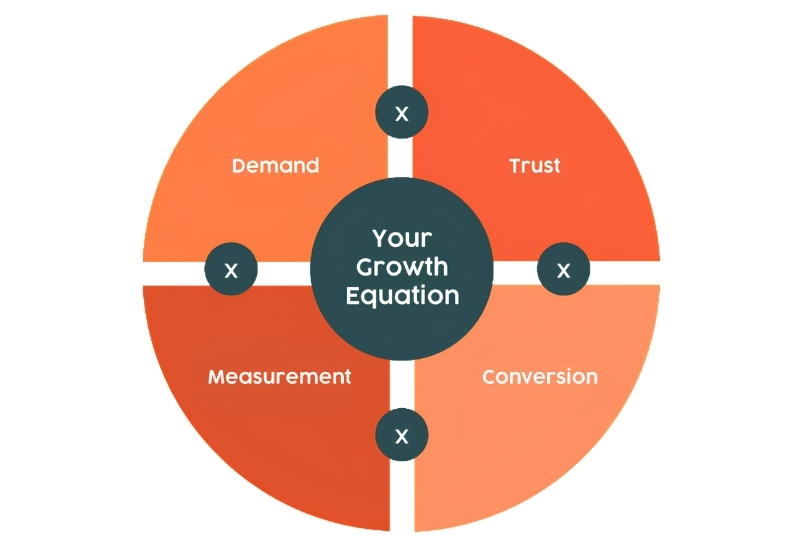
Four variables – but the most important part is the multiplication sign sitting between them.
Why it’s multiplication, not addition
If the four variables were simply added together, a weak spot would be manageable. Score well on three, fall short on the fourth, and you’d still land a reasonable total.
Addition is forgiving. Multiplication isn’t.
This isn’t a turn of phrase. It’s the actual mechanism behind most healthcare growth failures. When you multiply, any variable drifting toward zero drags the whole result down with it. You can have strong demand, a genuinely good product and clean reporting, but the moment trust collapses, growth plummets towards zero.
Recognising that equation reframes your question and informs your strategy. It changes the key question from “How do we improve everything at once?” to “Which of our four variables is closest to zero right now?”
What zero looks like in practice
Two examples make this concrete. Both businesses failed but at opposite ends of the same equation.
A few years ago, a platform launched in Australia with a genuinely strong idea: essentially Uber for allied health, where patients could book an appointment and have a practitioner come to them. The product was strong, the clinical value was real and the team was well funded. But the market had never felt the absence of it. Patients weren’t searching for it and clinicians weren’t asking for it. Demand sat at zero — and you can’t convert someone who doesn’t yet know they need you. This promising business burned through its runway trying to manufacture demand fast enough, and never got there.
In contrast, MediSecure failed at the other end of the equation. In 2024, the prescription service suffered a data breach exposing the records of roughly 12.9 million Australians. Demand and conversion were strong: they were processing prescriptions at scale. But trust went to zero — and not long after, so did the company.
Two businesses. Two different variables at zero. The same outcome. The equation doesn’t reward effort. It only cares whether all four variables are above zero and working together.
The four variables, in plain terms
Each variable earns its own article later in this series. Here’s an overview for now.
| Variable | What it means |
| Demand | Not awareness – alignment. Are you offering something that matches a problem the market is actively feeling right now? Demand makes you findable but not necessarily chosen. |
| Trust | Non-negotiable in healthcare, because the stakes are people’s health and private data. Your champion believes in you but they may have to convince everyone else and they rely on your reputation and credibility to do so. Trust builds slowly through small signals and can be destroyed in a single moment. |
| Conversion | You don’t just want someone to say yes once; you want their long-term loyalty. Common frictions include no online booking options for appointments or demos, outdated referral processes or failure to follow up on abandoned carts. The path to yes has to be easy because every obstacle deters buyers. |
| Measurement | Whether your buyer can prove to their own organisation that you were worth it. Most businesses report on activity like clicks, sign-ups and impressions when what actually survives a renewal conversation is outcomes. Value that only ever lived as a feeling rarely makes it through a budget cut. |
Which variable is yours?
| Variable | Business problems experienced |
| Demand | You have a strong product, but the right buyers aren’t finding you. |
| Trust | Deals stall or sales lag. Your champion believes in the product; the executive team isn’t convinced. |
| Conversion | Interest is there, but the pipeline stalls. You can’t pinpoint where it’s breaking. |
| Measurement | When you don’t know what the real issue is, you may invest in more activity but still not see improved outcomes. |
Fix the right thing first
Think of the equation as a diagnostic tool designed to guide your priorities, rather than judge your performance.
At any given moment, one of your four variables is closer to zero than the rest. That’s where your attention and your budget belong — not the channel that feels most urgent, not the tactic everyone else is running.
You cannot outspend a trust deficit. You cannot out-market poor workflow fit. You cannot scale what you cannot diagnose. Find the weakest variable. Fix it first. Then move to the next.
Healthcare growth comes down to earning more trust than your competitors with less friction in your conversion process. Before you spend another dollar, the Growth Equation asks you to identify which variable is closest to zero — and what are you doing about it?