

Part five of a series on diagnosing growth instead of guessing at it.
In the Healthcare Growth Equation (Growth = Demand × Trust × Conversion × Measurement), trust is the variable I treat with the most caution. Not because it’s the hardest to build, but because it’s the one most likely to silently collapse the entire equation while everything else still looks healthy.
A business can have strong demand, a smooth booking process and clean reporting, and still go to zero overnight if trust breaks. Because the variables multiply, trust doesn’t just weaken the result when it fails – it cancels it. This article unpacks why trust matters so much in healthcare, how it is built, and how to tell when it is undermining your growth.
Trust is felt, not claimed – and it compounds
The first thing to understand about trust is that you cannot assert your way into it. Few things raise suspicion faster than a business insisting, “Trust us!”
Trust is not a message you broadcast. It is a feeling that builds in someone else through small, consistent signals over time.
That’s worth sitting with, because it changes how you approach the work. Trust is built the way it is built in any relationship: slowly, through consistency, evidence and repeated proof that you are who you say you are. And, like any relationship, it can be damaged in a single moment. When trust breaks, you feel it – and you don’t easily forget.
In healthcare, the stakes are higher than almost anywhere else because people are trusting you with their health, their privacy and their clinical data.
In 2018, HealthEngine was the dominant booking platform in Australian healthcare. Then the ACCC found it had manipulated thousands of patient reviews and shared patient data without consent. They were fined $2.9 million, but the real cost was their market position.
Competitors that had been quietly building trust signals were suddenly given an opening. They did not need to outspend HealthEngine, because they were trusted more now. Once you lose trust in healthcare, you hold the door open for everyone else.
The layers that make trust real
Trust in healthcare is multifaceted. You need to see each facet to turn, “We should seem more trustworthy” into an actual plan.
Compliance is table stakes
Meeting AHPRA and TGA regulatory requirements isn’t a trust differentiator – it’s the floor you stand on to be taken seriously at all. But treat it as a source of credibility rather than a box to tick, because a business that visibly gets the regulatory layer right signals its professionalism to patients and partners alike.
Clinical evidence is what survives scrutiny
Outcomes, data, peer validation and published evidence are the proof points that hold up when someone starts asking harder questions. In healthcare, confidence is not built on optimism. It is built on accumulated proof.
Institutional validation answers “Who backs you?”
Accreditations, partnerships, affiliations, the credibility you borrow from established names willing to be associated with you.
Category authority has never mattered more
Your buyers are drowning in AI-generated content – consuming more of it and trusting less of it by the day. That makes the source matter more than ever. Your published point of view, original research, proprietary frameworks and leadership in the conversation all become trust signals.
In a market flooded with generic content, genuine authority is a competitive advantage. This is the layer many businesses neglect – and increasingly, the one that separates the trusted from the ignored.
The trust failure that looks like a marketing problem
Let me show you how this breaks in practice, because it rarely looks like a trust problem from the inside.
For B2B healthcare businesses, the pattern is painfully consistent. A clinician discovers your product. They love it. They become a champion and take it to procurement, the executive team, the board – putting their own reputation behind it. Then the meeting happens. Legal raises a flag. Procurement asks for compliance documentation that doesn’t exist yet. The executive team wants peer-reviewed evidence. And the champion, who genuinely believed in you, goes quiet.
That company didn’t have a marketing problem. They failed their champion. Their job was never just to build a trustworthy product – it was to equip the person who believed in them with the evidence needed to defend them to decision-makers.
This is also where trust reveals hidden depths depending on your corner of the sector. As one NDIS allied health CEO put it to me, “Trust hides a sub-multiplier most founders miss: referrer confidence with support coordinators, planners, and GPs. Demand and conversion are largely downstream of it.” In some worlds, trust lives upstream with the people who decide whether to refer. Lose their confidence and the funnel above you dries up before a patient ever hears your name.
How to tell if trust is your weakest variable
Trust is the hardest variable to self-diagnose, precisely because it fails quietly. A few honest signals:
- Your sales cycles are long and stall late – deals progress on enthusiasm, then go cold at the procurement, legal or board stage. That’s a defendability gap, not a demand gap.
- Champions love you in the room but can’t carry you through higher-level scrutiny in their own organisation.
- Your social proof, credentials and evidence are thin, scattered or missing from the places buyers look first.
- You’re winning on product but losing to competitors who are simply trusted more.
- In referral-driven models, the referrers who feed your business have gone quiet and you don’t quite know why.
The tell across all of these is the same: people who engage with you seem genuinely interested, and then something invisible stops them committing. That invisible something is usually trust.
What building trust actually looks like
It means putting trust signals where they can do their job quickly – often above the fold, in the first few seconds someone lands on your website.
Professional bios. Credentials displayed properly. Reviews or feedback mechanisms used only where compliant. An about page that asserts real authority and differentiation, rather than blandly describing what you do. Awards, memberships and accreditations shown in the places where they strengthen the decision. Compliance and disclaimers handled properly, protecting both the patient and the business.
Trust is not built by a single case study, credential or accreditation. It is built through the steady accumulation of evidence.
One proof point is a claim.
Ten is a pattern.
Twenty is a reputation.
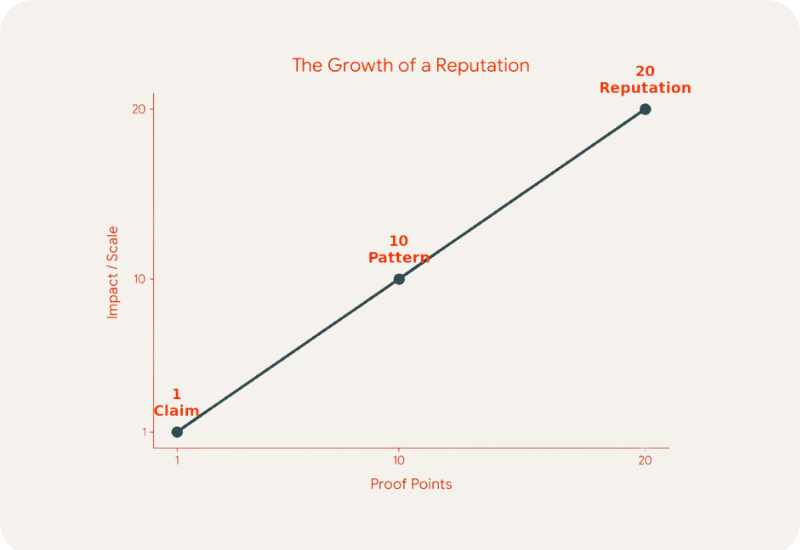
The work is to keep stacking that evidence until your credibility becomes hard to question – then equip your champions, referrers and buyers with it, so they can defend you in the rooms you are not in.
The bottom line
It is often the variable quietly holding growth back because trust failures rarely announce themselves clearly. They show up as long sales cycles, stalled deals, hesitant referrers, abandoned enquiries and interest that never becomes commitment.
And when the trust pillar crumbles, it demolishes the other three.
If your business is generating interest but not turning it into action, trust is the first place I would look. It is also exactly the kind of diagnosis our team makes every day.