

Part six of a series on diagnosing growth instead of guessing at it.
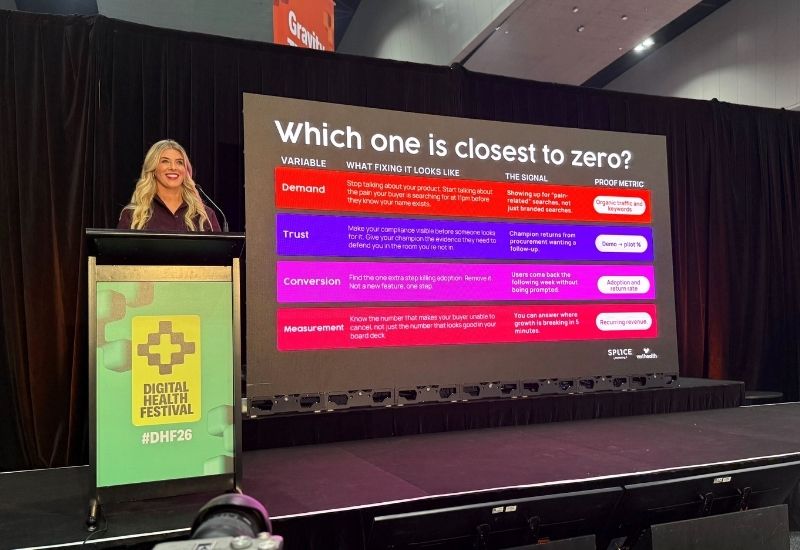
In the Healthcare Growth Equation (Growth = Demand × Trust × Conversion × Measurement), conversion is the variable where money leaks out speedily and invisibly. You’ve earned the demand. You’ve built the trust. Someone is interested, ready, even saying yes. And then, in the gap between decision and action, you lose them – and you almost never find out why.
This article shows you how to bridge that gap. We’ll explore what conversion really means, why friction is almost always the culprit, and how to create a smoother conversion process.
Conversion isn’t your win-loss rate
First, a definition, because the word gets used loosely. When I talk about conversion, I don’t mean your sales conversion rate – deals won versus deals lost. I mean the moment between someone deciding they want what you offer and actually acting on it. For a clinic, it’s the gap between “I should book that” and a confirmed appointment. For a healthtech product, it’s the gap between sign-up and the moment usage becomes a daily habit rather than another abandoned tool.
That gap is where most healthcare businesses bleed, and it almost always comes down to one thing: friction. If the path to action makes someone think harder, work longer, or take one extra step, you’ve lost them.
You’ve experienced this yourself. Every time you’ve started an online form that felt more demanding than your tax return and just closed the tab, that was a business losing you due to friction in the conversion process.
Friction is the enemy, and it hides in plain sight
The reason conversion problems are so expensive is that friction is invisible to the business creating it. You designed the booking form, so it doesn’t feel like friction to you. In fact, gathering all that data may actually be helpful to your internal processes, making the extra boxes seem trivial. But to the person on the other side, every extra question, every system glitch, every moment of “Wait, how do I do this?” is a reason to give up – and they leave without telling you.
The clearest example I know comes from clinical software. MedicalDirector runs systems used across the majority of Australian general practice. When AI scribes entered the market – genuinely useful tools saving GPs real time – the friction point was always the same. The GP would use the scribe during the consultation, then, once the patient left, they had to manually copy and paste the scribe’s notes into MedicalDirector. One extra step sits between the technology and the workflow. So MedicalDirector built Smart Scribe, an integration connecting AI partners like Heidi Health directly into the patient record. The note goes where it needs to go, inside the system the GP already uses. No extra step. The market didn’t fail because of that friction – it reorganised itself around removing it.
The lesson scales down to the simplest clinic. We worked with a high-end practice that had full pricing published openly on its website. We understood the instinct to be upfront about pricing, but we also saw potential patients taking fright before they understood the value and leaving without booking. So we offered something of value to download that showcased the offerings and carried the pricing inside it, giving context for the cost. It was gated content, which meant patients gave their email address to download it, allowing the clinic to nurture them over time. Same information, completely different conversion outcome – because the friction was removed at the exact point people were dropping off.
The two friction traps
Conversion problems tend to fall into two categories, and naming yours points straight at the fix.
Integration or process friction
This is when acting requires too much effort up front. In healthtech, that’s months of implementation, IT sign-off, custom development; nobody has time to implement something even if it would ultimately save them time. In a clinic, it’s the booking that requires a phone call during business hours, or a form that asks for too much information at the “getting to know you” stage.
Workflow or expectation mismatch
When the thing works, but only if the person changes how they already behave to access it. Every step that asks someone to deviate from their existing habit is a step where adoption dies.
The businesses that break through do the opposite of adding steps – they remove them, and they meet people where they already are. Heidi Health went directly to individual GPs and made it free to start: no IT approval, no implementation project. A clinician could try it in a single consultation, get value immediately, and tell a colleague. That was a conversion decision, not a marketing tactic. It reduced the effort required to say yes, turning one interested user at a time into momentum the business could scale.
Conversion is hiding retention
Conversion isn’t only about the first action. The same friction logic governs patient acquisition and retention alike. The nurture sequence that brings someone back next month, the follow-up after a first consultation, the recapture of a lead who went cold – these are all conversion, applied to the relationship rather than the first sale.
In healthcare, lifetime value and repeat and referral behaviour often matter far more than first-visit conversion. A business obsessing over the first booking while ignoring what happens after it is only reading half the variable. The full picture runs from the first click all the way through to the patient who comes back, and refers a friend, because every step of that journey was made easy.
How to tell if conversion is your weakest variable
Some honest signals that conversion is your binding constraint:
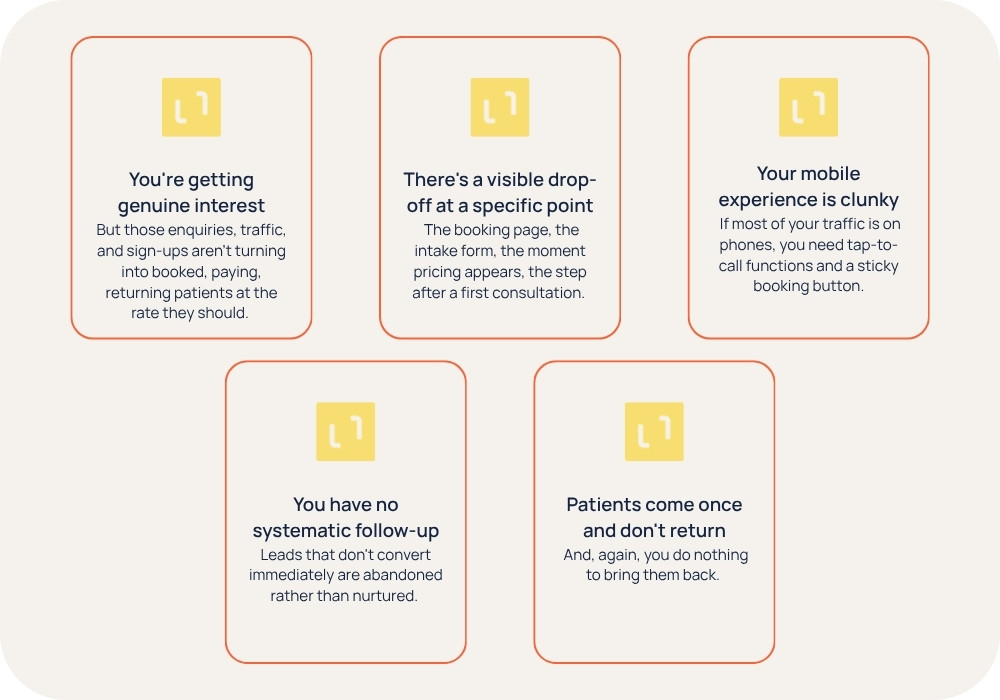
If demand is bringing people to the door and trust is making them willing, but they still aren’t acting, conversion is where your growth is leaking.
What fixing conversion looks like
Conversion is the most mechanical of the four variables, which is good news – it responds quickly to deliberate work. Find the single change that removes the most friction for the least effort, and start there.
In practice that means:
- Shortening forms to only the essential fields
- Testing the booking flow on mobile as ruthlessly as on desktop
- Adding tap-to-call buttons and sticky enquiry buttons for mobile users
- Regularly reviewing the patient journey to find and remove friction points
- Building a real lead-handling and follow-up process, including SMS recapture for people who didn’t book the first time.
- Mapping the whole conversion journey end to end, from first interest through to retention, so no step is left to chance.
It’s worth the effort. We helped one company improve its conversion rate by 20% using a mix of these strategies.
The bottom line
Conversion is where the work of demand and trust either pays off or disintegrates. The money you lose here is the hardest to see, because a patient who gives up doesn’t fill in a form to tell you they’ve gone. Removing friction – at the booking, in the follow-up, across the whole journey from first click to returning patient – is often the fastest, highest-leverage growth available to a healthcare business.
If you’re generating interest that isn’t converting into booked and returning patients, there’s almost certainly friction you can’t see from the inside.